Diophantus of Alexandria - (Greek: Διόφαντος ὁ Ἀλεξανδρεύς , circa 200/214 – circa 284/298) was a Greek mathematician of the Hellenistic era. Little is known of his life except that he lived in Alexandria, Egypt ...
He was known for his study of equations with variables which take on rational values and these Diophantine equations are named after him. Diophantus is sometimes known as the
father of Algebra. He wrote a total of thirteen books on these equations. Diophantus also wrote a treatise on polygonal numbers.In 1637, while reviewing his translated copy of Diophantus' Arithmetica (pub. ca.250) Pierre de Fermat wrote his famous
Last Theoremin the page's margins. His copy with his margin-notes survives to this day.Although little is known about his life, some biographical information can be computed from his epitaph. He lived in Alexandria and he died when he was 84 years old. Diophantus was probably a Hellenized Babylonian.
A 5th and 6th century math puzzle involving Diophantus' age: He was a boy for one-sixth of his life. After one-twelfth more, he acquired a beard. After another one-seventh, he married. In the fifth year after his marriage his son was born. The son lived half as many as his father. Diophantus died 4 years after his son. How old was Diophantus when he died?
What is the answer, with reasoning? (It is in the source-file.)
In all of my courses, attendance is absolutely required (excepting illness and religious holidays). In the unfortunate event that you miss a class, you are responsible to get all Notes / Announcements / TheWholeNineYards from a classmate, or several. All my classes have a substantial class-participation grade.
The Euclidean algorithm can be presented in table-form; I call this form the Lightning-bolt algorithm (pdf), because the update-rule looks like a lightning-bolt (used thrice). Here is a practice sheet for LBolt (pdf).
The first page of
 Algorithms in Number Theory (pdf)
uses LBolt iteratively to compute the GCD of a list of integers,
together with a list of Bézout multipliers.
Page 2 uses LBolt to solve linear congruences:
Algorithms in Number Theory (pdf)
uses LBolt iteratively to compute the GCD of a list of integers,
together with a list of Bézout multipliers.
Page 2 uses LBolt to solve linear congruences:
Find all x where 33x is mod-114 congruent to 18.
SOTSin the notes.
| Author: | James K. Strayer | Edition: | 2002 |
| ISBN: | 1577662245 | Publisher: | Waveland (Reissue edition, blue & purple cover) |

Summer 2018, Number Theory 1:
Number Theory czars who help out.
| Projector | Phone-list | Chalk | E-Probs | Time | Humor | Haberdasher |
|---|---|---|---|---|---|---|
| Lizzie | Big Al | Roma | DanDan & Brandon | Jared | DJ | Scott |
Find all x where 33x is mod-114 congruent to 18.
Summer 2016, Number Theory 1:
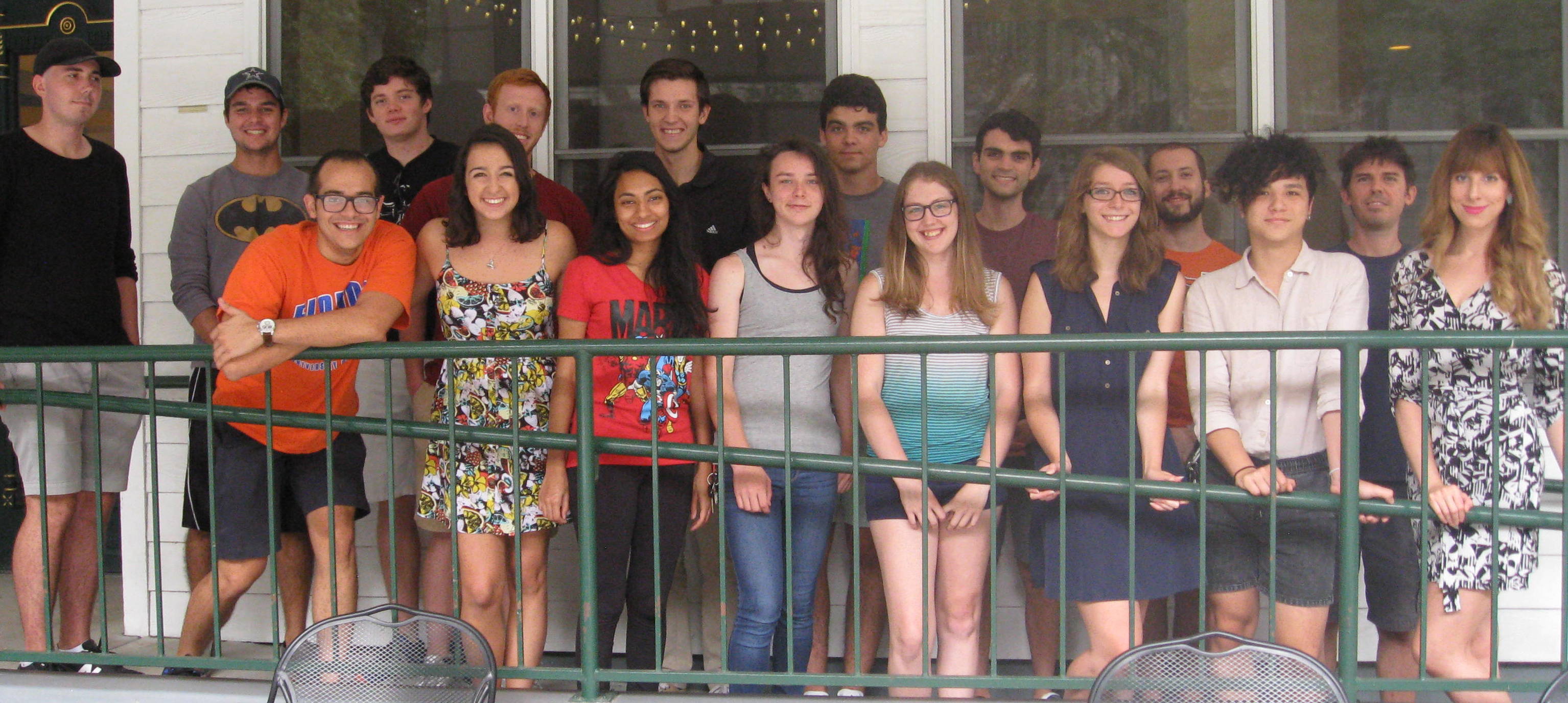
The friendly puzzles of our congenial Games-party continued on Friday with the mind-expanding Class-C (pdf), bringing our Number Theoretic summer to a satisfying finale (knowing that there is still much to learn).
Newspaper headlines across the country proclaimed,
The perfect sequel!
The right parenthesis... to the left-parenthesis of Class-A
.
One contestant waxed lyrical,
It had my favorite characters, in action-packed circumstances.
The mathematical and emotional equivalent of a good James Bond movie
... --I was stirred, but not shaken.
.
With a twinkle in his eye, he quipped
And, finally, someone gave Hensel a lift...
.
Over a pleasant day at the beach, we linger. Over a marvelous meal with friends, we linger. By this criterion, Monday's leisurely Class-B (pdf), was the root cause of sustained universal pleasure.
Newspaper headlines across the country proclaimed,
Class-B revolutionary --Time stands still!
.
Opined one participant, It has everything!
he enthused deliriously,
Including one Fusion too many ,,,
(Prof. K is evidently proFusion)
.
Eager puzzle-solvers worldwide breathfully await the next installment.
Shouts of Joy greeted the beguiling Class-A (pdf), whetting people's appetite for further Number Theoretic gems. Flowers and gold coins were tossed on the stage by an appreciative audience, as crowds gathered to cheer the elegance of the exam.
Newspaper headlines across the country proclaimed,
Class-A a triumph!
, splashed across the front page in 19-point font.
It has everything!
, gushed one audience member,
Mystery!, Sophistication!, Suspense!
.
Avid readers everywhere are looking forward to the next installment.
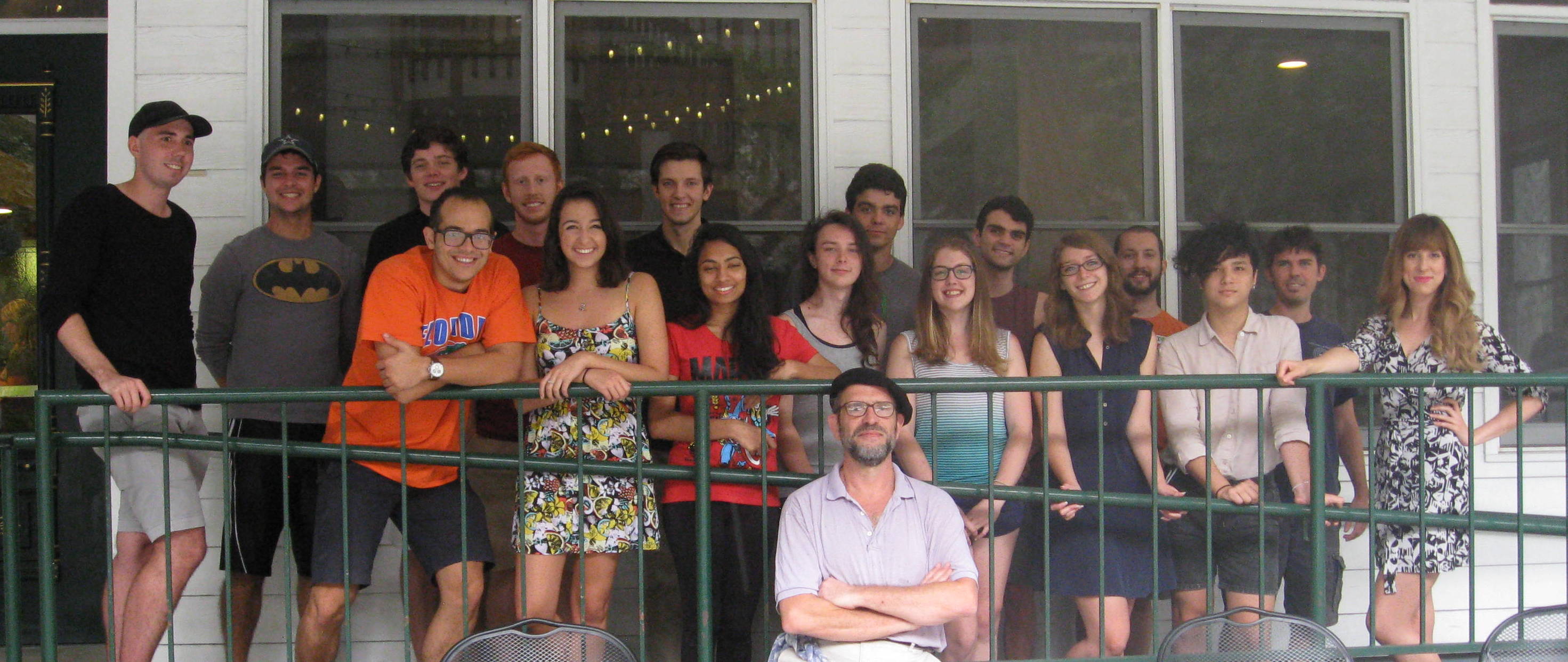
Number Theory czars who helped out.
| Projector | Phone-list | Blackboard | E-Probs | Time | Humor/Chocolate |
|---|---|---|---|---|---|
| Mark | Hunter | (Everyone) | Ariana | Ariana | Andrea aka Bubba |
Spring 2007, Number Theory:
The various Number Theory czars who helped out.
| Projector | Phone-list | Chalk | Blackboard | H-Probs | Time |
|---|---|---|---|---|---|
| Rebecca | Cameron | Charlye | Marshall | Jimmy-C & Dream | Cameron |
The joyous Home-A (pdf), exists.
General gaity and acclaim greeted the smooth Class-A (pdf) with its CRT computation.
The fabulous Home-B (pdf), was due Thurs., 01March.
The Fascinating Class-B (pdf) was moved later to Mon., 26March. Please have brought lots of lined-paper and a calculator, since some of the numbers may have been large.
The point-producing Bonus-B (pdf), after the extension, was due Tuesday, 10Apr.
Spring 2006, Number Theory 1
May the Force be with you! Since time-travel into the Future is now possible, you may wish to visit the Spring 2007 webpage for the Time-Travel version of this course.
| Author: | William J. Leveque | ISBN: | 0-486-68906-9 |
| Year: | 1996 | Publisher: | Dover |
Autumn 2006, Computational Number Theory

Welcome! to a continuation of my Number Theory 1 of Spring2006.
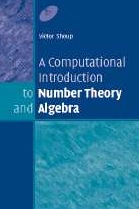
| Author: | Victor Shoup | ISBN: | 0-521-85154-8 |
| Year: | 2005 | Publisher: | Cambridge University Press |
Spring 2000, Number Theory 1
[I taught a Continuation of this course, NT2, in Spring 2001.]
| Authors: | Ivan Niven, Herbert S. Zuckerman, Hugh L. Montgomery | ISBN: | 978-0-471-62546-9 |
| Year: | 1991 | Publisher: | John Wiley & Sons |
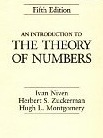
This is a classic number theory textbook
(Niven & Zuckerman
),
updated by Hugh Montgomery. It is renowned for its excellent problems.
The plan is to cover chapters 1-4, and parts of chap. 5.
Prof. Hugh Montgomery maintained an errata sheet (pdf) for the NZM text.
Prof. Ken Ribet's has a guide to
several NT books.
His references to “Math 115”
refer to his number theory course, not mine!
(Note that I
and my
are Prof. Ribet speaking.)
![[Image: Coffee cup]](Images/coffee2.gif) Homework and reading.
Homework and reading.![[Image: Steaming coffee cup]](Images/java.gif) Exams and Projects
(Number Thy)
Exams and Projects
(Number Thy)
 (2000) (2000) |
 |
|---|---|
| Mon. 07Feb | Exam-Z (pdf): [In class.] The exam may cover material through the end of the Binomial section, NZM 1.4. |
| Fri. 18Feb | Quiz Q1: Soln to Q1 (txt). |
| Wed. 22Mar | Exam-Y (pdf): Held in room LIT368 from 5PM-6:30PM. Please bring a hand-held calculator for this open-brain closed-book exam. |
| TBS | Exam-X (pdf): There will be no final-exam during exam week. |
Spring 2001, Number Theory 2
Welcome! This is the continuation of my Number Theory 1,
There were 6 questions, Q0,Q1,…,Q5. q0-1.NT2001g (txt), q2-NT2001g (txt), q3-NT2001g (txt), and q4-5.NT2001g (txt).
I plan to run this more as a seminar than as a standard Learn/Exam/Learn/Exam… course. While I expect that I will present the lion's share of the material, I hope to encourage students to perhaps give some prepared talks on a particular problem or subject.
As such, I expect that every student who attends regularly and participates in the discussions will earn an A. There will be some graded homework, and you can do homework singly or jointly, as you choose.
We plan to cover much of Chapter 5 of our textbook An Introduction to the Theory of Numbers (5th edition) by Ivan Niven, Herbert S. Zuckerman and Hugh L. Montgomery.
We'll review modular arithmetic and the Chinese Remainder Thm. Then cover the Legendre and Jacobi symbols. We'll then solve certain Diophantine equations (DE), roughly following chapter 5 of NZM.
We will prove Lagrange's theorem that every positive integer is a sum of exactly 4 perfect squares (allowing the square of zero). Exercise: How is 150 a sum of four squares? Lagrange's proof using the beautiful and elementary "proof by Infinite Descent" method of Fermat. It gives an algorithm for finding four such squares.