Schedule
Teaching
PAST-COURSES
SeLo 2024g
Plex 2024g
past SeLo
past LinA
past DfyQ
past Plex
past Abstract Algebra
past NT&Crypto
Combinatorics 2017-2018
Fonts
Articles
Michael Dyck's Contradance Index
Michael Dyck's Contradance Index
Jonathan's dances
Dances/Composers (contradance)
Tunes/Bands (contradance)
L0 Contradance program
L1 Contradance program
L2 Contradance program
L3 Contradance program
L4 Contradance program
L5 Contradance program
Navigation
JK Top
MAT4930 0329 (25286) Number Theory & Cryptography MWF7 [13:55-14:45]
Spr2023:
LittleHall 219(SW)
Number Theory & Mathematical Cryptography
 Cryptographic resources
-
Something for Everyone!
Our NT&Codes IOP
is available.
- Vandermonde matrices are non-singular.
w:Disriminant of a univariate polynomial.
Work-in-progress: Linear Codes.
- w:Finite fields.
See also
Finite fields have cyclic multiplicative groups (pdf).
(This also proves the Primitive Root Thm,
and Korselt's Thm characterizing the
Carmichael numbers.)
Also:
FFFF (Further Finite Field Facts)
and
a sort-of
exploratory introduction to finite fields.
w:Vandermonde matrix.
Mary Wootters has a sequence of nice videos on Algebraic Coding Theory.
Useful are:
Intro to Linear Codes
and
Intro to Reed-Solomon ECCs.
-
-
The delightful
Class-V
was available
after
Home-V
was handed-in.
Hensel's Lemma (pdf),
for a lifting a mod-p root of a polynomial, to be a root mod pn.
- Look Ma! All 11
Cryp quizzes (pdf)
![[Image: Updated]](Images/updated.gif) [Friday, 14Apr2023]
[Friday, 14Apr2023]
- Data compression:
Prof. King's CodeNotes (pdf).
We will also use a
paper I wrote for Springer Publishing.
- Our
NT & Crypto syllabus..
- We'll use parts of
Quad-reciprocity & Jacobi symbol,
as well as
Legendre symbol.
We also have a
previous posting on the Jacobi symbol.
- Related to the above:
w:Euler pseudoprime
and
w:Solovay-Strassen primality test
and
w:Miller-Rabin primality test.
In the ballpark:
w:Zolotarev's lemma
- The delightful
Class-U.
-
Voici
Home-U.
Your typeset, stapled Home-U
was due no later than
11:30AM, on Wedn., 22Feb.,
slid completely under my office door, LIT402.
- Huffman codes. Huffman's theorem on minimum expected coding-length codes.
[For the curious,
Huffman's original 1952 paper (pdf).]
Uniquely-decodable codes and the Kraft-McMillan theorem.
- Homophonic substitution cipher,
and Homophonic cipher, and a
Paper on breaking a homophonic cipher (PDF).
- Mary Queen of Scots lost letters and a
partially decrypted text.
- DECRYPT Project.
- Historical Cryptography
(Trinity College).
- Sample chapters from the
Handbook of Applied Cryptography.
(I have not reviewed this book.)
- Crypto-Gram Newsletter.
Has an
applied
approach to cryptography.
- If she saw this,
 (TAotDM)
,
WWSKnow?
(TAotDM)
,
WWSKnow?
- The decipherment of a substitution cipher appears in
The Gold Bug,
by Edgar Allan Poe.
Our
Teaching Page
has important information for my students.
(It has the
Notes, Exams and Links
from all of my previous courses.)
The
Teaching Page has
my schedule,
LOR guidelines,
and
Usually Useful Pamphlets.
One of them is the
Further information is at our
class-archive URL
(I email this private URL directly to students).
In all of my courses,
attendance is absolutely required
(excepting illness and religious holidays).
In the unfortunate event that you miss a class, you are
responsible to get all
Notes / Announcements / TheWholeNineYards
from a classmate, or several.
All my classes have a
substantial
class-participation grade.
NT&Cryptography topic list
- Modular arithmetic
and
repeated-squaring. Also: The h-orbit of a point, where h() is a function.
- We'll warm up with
w:Caesar ciphers
and
w:Affine ciphers.
A changing Caesar cipher is called a
w:Vigenere cipher.
(Shall we listen to
(Blaise de) Vigenere?).
One can generalize to
w:Hill-type codes, using
matrix multiplication mod-N.
The Euclidean algorithm can be presented in table-form; I
call this form the
Lightning-bolt algorithm (pdf),
because the update-rule looks like a lightning-bolt (used thrice).
Here is a
practice sheet for LBolt (pdf).
The first page of
 Algorithms in Number Theory (pdf)
uses LBolt iteratively to compute the GCD of a list of integers,
together with a list of Bézout multipliers.
Page 2 uses LBolt to solve linear congruences:
Algorithms in Number Theory (pdf)
uses LBolt iteratively to compute the GCD of a list of integers,
together with a list of Bézout multipliers.
Page 2 uses LBolt to solve linear congruences:
Find all x where 33x is mod-114 congruent to 18.
Here are examples of
fusing congruences (txt)
using LBolt
- Euler phi function. Fermat's Little Thm. Euler-Fermat Thm (EFT).
w:Euler's totient fnc.
(Euler pronunciation)
Related, is the
w:Carmichael fnc.
- The important
Chinese Remainder Thm (pdf) [CRT]
tells us the structure of
ZedM.
The CRT is an example of a Ring-isomorphism.
[A corollary of CRT is that Euler-phi is multiplicative.]
An example of
using CRT to count roots of a polynomial (txt).
(Time permitting, we may learn that
Finite fields have cyclic multiplicative groups (pdf).
This pamphlet also proves the Primitive Root Thm,
and Korselt's Thm characterizing the
Carmichael numbers.)
- Possibly: Notes-in-progress on
Fermat's SOTS (Sum-Of-Two-Squares) thm.
Slides showing how the Euclidean Algorithm writes a given N as a
Sum Of Two Squares (pdf).
Such an N is a SOTS
in the notes.
-
xkcd Cryptography
- Diffie-Hellman key exchange and
ElGamal Cryptosystem.
Shank's Baby-step Giant-step method attempting to break
the Diffie-Hellman protocol.
- The RSA Cryptosystem.
- Miller-Rabin probabilistic factorization algorithm.
- Pollard-ρ factorization algorithm.
Descent-from-the-Top algorithm for computing the
mod-M multiplicative order of an element.
- Likely: Along
the way to developing cryptographic methods, we will solve a number
of Diophantine equations, that is, algebraic equations where the only
solutions that we allow are using integers.
We will find all
Pythagorean Triples (pdf)
(a,b,c) of positive integers for which
a2 + b2 = c2 .
We will discover that there is a two-parameter family of such solutions.
- Partial Theorem List (pdf)
[LBolt. Irred vs. prime. FLiT. ERT. Wilson's thm. LST.
Quadratic-reciprocity thm.]
for Number Theory.
A topics guide (txt)
for an exam from Spring 2013.
- Likely: Elias delta code;
also, some
example prefix codes (txt, Lisp computation).
Possibly:The Ziv-Lempel adaptive code
and the
empirical Entropy of English.
(Thanks, Aidan; 2013g.)
The above “entropy” link references
and experiment by Claude Shannon; to run, it
needs Java enabled.
- Possibly: The historically-important
Meshalkin Example (pdf)
of two isomorphic Bernoulli processes, with different distributions
yet the same entropy.
- Error-correcting codes:
Hamming codes. Golay codes.
Extra resources and possible extra topics
- UF pays a fee so that students can use the professional version of
Overleaf, a free LaTeX typesetter.
- Pollard's
p − 1
factorization algorithm.
- LBolt over the Gaussian Integers.
Proving unique factorization in the Gaussian Integers. Using LBolt to write
certain primes as sums-of-two-squares.
- Hensel's Lemma (pdf) for lifting a
mod-p root of a polynomial, to be a root mod pn.
- Intro to
Multiplicative Functions (pdf) and
Dirichlet convolution of
number-theoretic functions, such as Euler-phi.
- Wilson's thm
and the w:Legendre/Jacobi Symbol
[Defn of
the Jacobi symbol (Top // Bottom)
starts on P.4 of
Quadratic Reciprocity (pdf).
It is preceded by a proof of Quadratic Reciprocity, and has
proofs of the Eisenstein and Gauss Lemmata.]
- Polytime testing whether N is a prime-power.
Perhaps: AKS polytime primality-test algorithm.
See
w:Primality testing.
Also:
w:Links to original AKS article, and improvements.
- Shannon source-coding thm. Shannon's Noisy-channel thm.
- Using Smith Normal Form
of a matrix to solve a system of linear Diophantine Eqns.
- Ambitious
(Some Analytic NT): Distribution of Primes: Chebyshev thm,
Bertrand's postulate, PNT (Prime Number Thm).
- MathPages.
(A list of miscellaneous Number Theory topics.)
Chosen plaintext attack
- Alice publishes how to send her an RSA-encrypted message.
End-of-semester NT&Crypto
Individual (Optional) Project (IP)
...will be due,
typed,
stapled,
slid completely under my office door
(402 Little Hall, northeast corner, top floor)
no later than
2PM, Thursday, 27Apr2023.
The Project must be carefully typed,
but diagrams may be hand-drawn and scanned into the PDF.
The first page is to be the
Problem Sheet,
with Honor Code signed and blanks filled in.
At all times have a paper copy you can hand-in; I do
NOT accept
electronic versions.
Print out a copy each day, so that you always have the latest version to
hand-in; this, in case your printer or computer fails.
(You are too old for My dog ate my homework.
)
Please follow the guidelines on the
Checklist  (pdf, 3pages) to earn full credit.
The following is abridged from
Wikipedia, the free encyclopedia
Diophantus of Alexandria -
(Greek:
Διόφαντος ὁ Ἀλεξανδρεύς ,
circa 200/214 – circa 284/298)
was a Greek mathematician of the Hellenistic era. Little is
known of his life except that he lived in Alexandria, Egypt ...
He was
known for his study of equations with variables which take on rational
values and these Diophantine equations are named after him. Diophantus is
sometimes known as the father of Algebra
. He wrote a total of thirteen
books on these equations. Diophantus also wrote a treatise on polygonal
numbers.
In 1637, while reviewing his translated copy of Diophantus'
Arithmetica
(pub. ca.250)
Pierre de Fermat wrote his famous Last Theorem
in the
page's margins. His copy with his margin-notes survives to this day.
Although little is known about his life, some biographical information can
be computed from his epitaph. He lived in Alexandria and
he died when he was 84 years old. Diophantus was probably a Hellenized
Babylonian.
A 5th and 6th century math puzzle involving Diophantus' age:
He was a boy for one-sixth of his life. After one-twelfth more, he
acquired a beard. After another one-seventh, he married. In the fifth year
after his marriage his son was born. The son lived half as many as his
father. Diophantus died 4 years after his son. How old was Diophantus when
he died?
What is the answer, with reasoning?
(It is in the source-file.)
The following is from
Wikipedia, the free encyclopedia
Cryptography (or cryptology; derived from Greek
κρυπτός kryptós "hidden",
and the verb
γράφω gráfo "write")
is the study of message secrecy. In
modern times, it has become a branch of information theory, as the
mathematical study of information...
...
Steganography (i.e., hiding even the existence of a message so as to
keep it confidential) was also first developed in ancient times. An early
example, from Herodotus, concealed a message - a tattoo on a slave's
shaved head - by regrown hair.
More modern examples of steganography
include the use of invisible ink, microdots, and digital watermarks to
conceal information .
Ciphertexts produced by classical ciphers always reveal statistical
information about the plaintext, which can often be used to break
them. After the Arab discovery of frequency analysis (around the year
1000), nearly all such ciphers became more or less readily breakable by an
informed attacker.
...
Essentially all ciphers
remained vulnerable to cryptanalysis using this technique until the
invention of the polyalphabetic cipher by Leon Battista Alberti around the
year 1467. Alberti's innovation was to use different ciphers (ie,
substitution alphabets) for various parts of a message (often each
successive plaintext letter). He also invented what was probably the first
automatic cipher device, a wheel which implemented a partial realization
of his invention. In the polyalphabetic Vigenère cipher, encryption uses a
key word, which controls letter substitution depending on which letter of
the key word is used.
Prerequisites:
A grade of
B in
UF's
Sets & Logic [MHF3202]
or
Discrete Structures [COT3100] course
(or equivalent)
OR
permission of the professor.
(I would like you to know:
What a prime number is,
and What mathematical induction is
and What an equivalence relation is.
Helpful
is knowing how to: Add/multiply two numbers mod-N,
and how to compute mod-N reciprocals, i.e, the
Extended Euclidean Algorithm.
Helpful, but not required,
is the definition of the Euler phi function.)
See Useful NT Texts, below,
for self-study suggestions.
Assignment for first week of class.
- To help you self-evaluate,
take up to 65 minutes to solve as many
problem as you can, on
this
test of high-school mathematics, with a touch of Sets&Logic(pdf).
- Memorize the
useful Math-Greek alphabet (pdf).
- Get the basics of
w:Set-builder notation
(up through “Equivalent predicates...”).
Important:
For us, the (double-bar N)
symbol
ℕ={0,1,2,...};
i.e zero is a natural number, a natnum.
We use
ℤ+={1,2,3,4,...}
for the set of positive integers; the posints.
Encryption
Various math czars who help out.
| Time |
Computer/Proj |
Lights |
Blackboard |
Humor |
EN-Problems |
| Austin |
Brandon |
Luke |
everyone |
Alejandro |
Brandon D. |
ENCODING:
a b c d e f g h i j k l m n o p q r s t u v w x y z ' . ? ! ,
0 1 2 3 4 5 6 7 8 9 10 11 12 13 14 15 16 17 18 19 20 21 22 23 24 25 26 27 28 29 30 31
Three Examples of simple ciphers:
CAESAR:
Shift by 9:
x ↦ x+9 (mod 32).
a b c d e f g h i j k l m n o p q r s t u v w x y z ' . ? ! ,
9 10 11 12 13 14 15 16 17 18 19 20 21 22 23 24 25 26 27 28 29 30 31 0 1 2 3 4 5 6 7 8
MULTIPLICATIVE-CIPHER;
Mult by 5:
x ↦ [5*x] (mod 32).
[Uses that 5 is coprime to 32]:
a b c d e f g h i j k l m n o p q r s t u v w x y z ' . ? ! ,
0 5 10 15 20 25 30 3 8 13 18 23 28 1 6 11 16 21 26 31 4 9 14 19 24 29 2 7 12 17 22 27
AFFINE-CIPHER;
Mult by 5, then add 9:
x ↦ [5*x]+9 (mod 32).
a b c d e f g h i j k l m n o p q r s t u v w x y z ' . ? ! ,
9 14 19 24 29 2 7 12 17 22 27 0 5 10 15 20 25 30 3 8 13 18 23 28 1 6 11 16 21 26 31 4
The following, from
Wikipedia (Enigma_machine),
is
edited and
abbreviated.
In December 1932, the Polish Cipher Bureau first broke
Germany's Enigma ciphers. Five weeks before the outbreak of
World War II, on 25 July 1939, in Warsaw, the Polish Cipher
Bureau gave Enigma-decryption techniques and equipment to
French and British military intelligence.
…[A]llied codebreakers were able to
decrypt a vast number of messages that had been enciphered
using the Enigma. The intelligence gleaned from this
source was codenamed “Ultra” by the British.
[After World War II] Winston Churchill told Britain's King
George VI:
It was thanks to Ultra that we won the war.
Though the Enigma cipher had cryptographic weaknesses, in practice it was
only in combination with other factors
(procedural flaws, operator
mistakes, occasional captured hardware and key tables, etc.)
that those weaknesses allowed Allied cryptographers to be so successful.

JK Home page


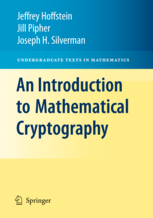 Our textbook is
An Introduction to Mathematical Cryptography
(Undergraduate Texts in Mathematics).
Our textbook is
An Introduction to Mathematical Cryptography
(Undergraduate Texts in Mathematics).
